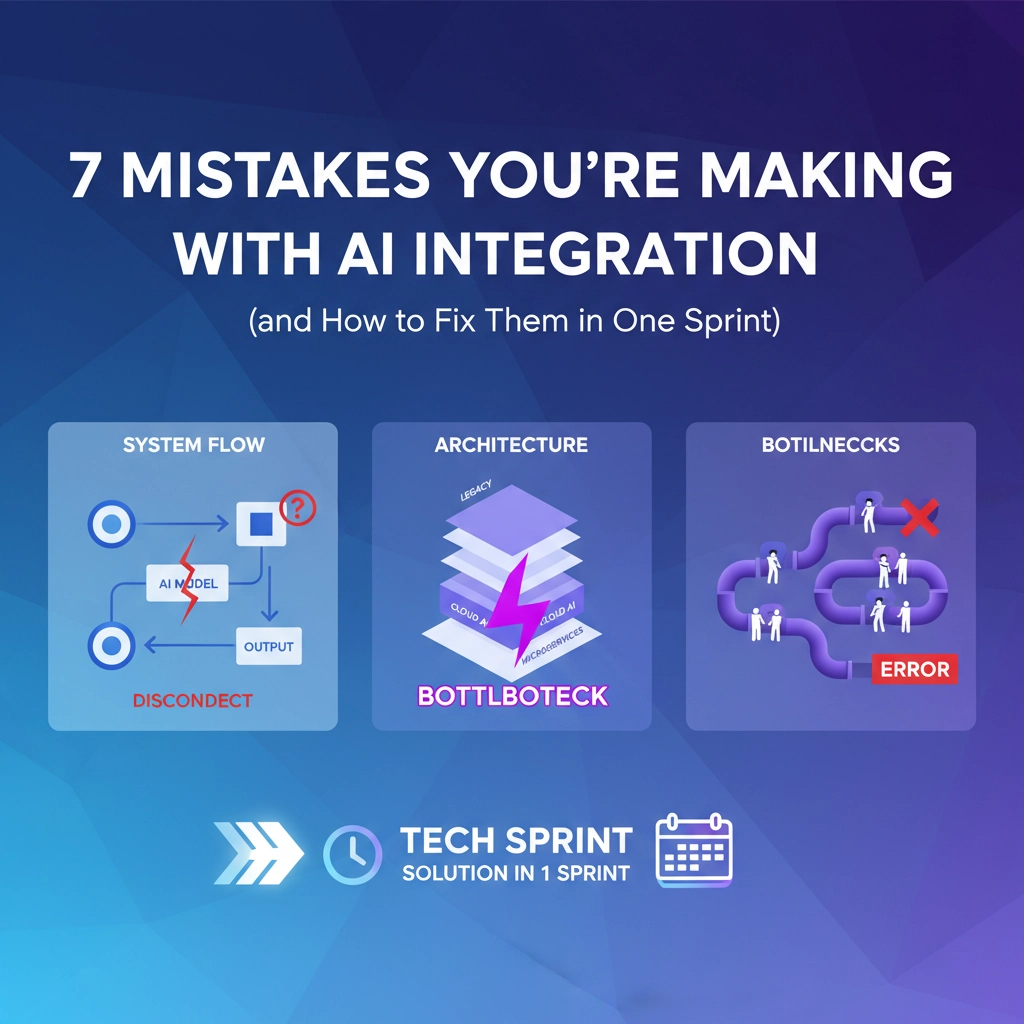
After helping 200+ FinTech, EdTech, and InsureTech founders integrate AI into their products over the past 3 years, I’ve seen the same costly mistakes destroy promising initiatives. 87% of AI projects fail within the first 18 months: but it’s not because AI doesn’t work.
It’s because founders make predictable integration mistakes that torpedo results before they start seeing ROI.
Here’s what I’ve learned from debugging failed AI implementations: every mistake follows the same pattern, and every fix can be implemented in a single sprint. No 6-month roadmaps. No million-dollar consulting fees. Just focused execution that transforms your AI from expensive experiment to revenue driver.
Mistake #1: Launching Without a Bulletproof Strategy
The brutal reality: 73% of companies adopt AI tools because competitors use them, not because they solve specific business problems. This “shiny object syndrome” burns through budgets faster than any technical failure.
I’ve watched startups spend $50K on AI platforms that sit unused because nobody defined what success looks like. Your AI initiative is dead on arrival without a crystal-clear problem statement and success metrics.
The Sprint Fix:
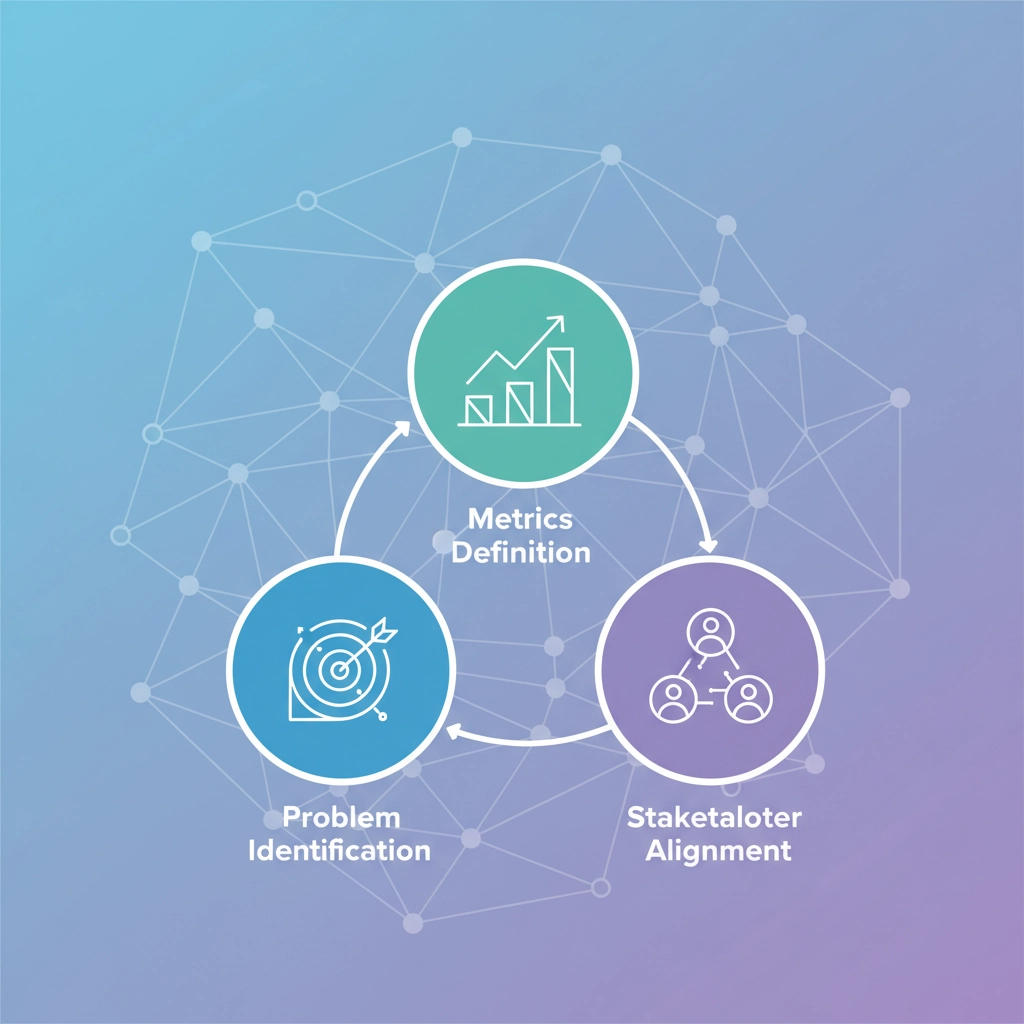
- Day 1-2: Map your top 3 revenue-killing or efficiency-draining problems
- Day 3-4: Define measurable success metrics for each use case (30% faster processing, 50% reduced manual work, 25% higher conversion rates)
- Day 5: Align all stakeholders on priorities and expected ROI within 90 days
- Result: A documented problem-solution fit that prevents feature creep and scope drift
Mistake #2: Building on Garbage Data (The Silent Killer)
The painful truth: Poor data quality causes 60% of AI model failures in production. Most founders collect “more” data instead of “good” data, creating biased outputs that damage user trust and business outcomes.
I’ve seen FinTech startups launch AI-powered risk assessments that discriminated against entire demographic groups because their training data was incomplete. One bad data decision can tank your entire product reputation.
The Sprint Fix:
- Day 1: Audit existing data sources for completeness, accuracy, and bias using statistical analysis
- Day 2-3: Implement automated data validation pipelines that catch errors before training
- Day 4-5: Establish data governance standards with clear ownership and cleaning procedures
- Result: Clean, validated datasets that produce reliable AI outputs from day one
Mistake #3: Ignoring Your Team (The Change Management Disaster)
The harsh reality: Employee resistance kills AI adoption faster than any technical bug. 68% of AI implementations fail because teams refuse to trust or use new systems. Your $100K AI investment becomes worthless if your people won’t use it.
I’ve watched brilliant AI solutions gather digital dust because founders skipped change management. Users create workarounds, maintain shadow processes, and actively sabotage systems they don’t understand or trust.
The Sprint Fix:
- Day 1-2: Design hands-on training sessions that show AI’s specific benefits for each role
- Day 3-4: Create feedback channels where employees report issues and suggest improvements
- Day 5: Establish AI champions in each department to drive adoption and address concerns
- Result: 90%+ user adoption rates within 30 days instead of months of resistance

Mistake #4: Solution Shopping Before Problem Definition
The expensive mistake: 82% of startups choose AI platforms before fully understanding their requirements. They fall for flashy demos and generic capabilities that don’t integrate with existing workflows.
I’ve seen EdTech companies waste 6 months trying to force-fit popular AI tools into their unique content management needs. Generic solutions create generic results: and frustrated teams.
The Sprint Fix:
- Day 1-2: Document exact workflow requirements and integration points before any vendor demos
- Day 3-4: Test 2-3 platforms with real data and actual user scenarios, not sanitized demos
- Day 5: Score solutions based on workflow fit, not feature lists or pricing alone
- Result: AI tools that enhance existing processes instead of disrupting productive workflows
Mistake #5: Running Duplicate Processes (The Efficiency Killer)
The productivity paradox: 91% of companies maintain manual processes alongside AI “just in case,” creating double work instead of efficiency gains. Teams lose confidence in AI when they’re forced to verify every output manually.
This destroys ROI faster than any technical issue. If your AI requires full human verification, you’re not automating: you’re adding steps.
The Sprint Fix:
- Day 1: Identify which manual processes AI will replace versus augment
- Day 2-3: Create phase-out timelines with specific confidence thresholds for retiring manual workflows
- Day 4-5: Build fallback procedures for edge cases, not full duplicate processes
- Result: True efficiency gains where AI handles 80%+ of routine work without human bottlenecks

Mistake #6: Flying Blind Without Monitoring
The invisible disaster: AI models degrade silently in production. 76% of companies deploy AI without proper monitoring, causing error rates to spike undetected until customer complaints explode.
I’ve debugged AI systems making increasingly bad decisions for months because nobody tracked performance drift. Silent failures are the most expensive failures.
The Sprint Fix:
- Day 1-2: Build automated dashboards tracking model accuracy, response times, and error rates
- Day 3-4: Implement human-in-the-loop validation for high-stakes decisions
- Day 5: Set up alert systems when performance drops below acceptable thresholds
- Result: Early warning systems that catch problems before they impact customers or revenue
Mistake #7: Treating Security and Ethics as Optional
The reputation destroyer: Privacy violations and biased AI outputs create legal nightmares and PR disasters. 43% of companies skip ethics reviews because they slow development: until they face regulatory investigations.
One biased hiring algorithm can trigger million-dollar lawsuits. One data breach can destroy years of trust. Security and ethics aren’t nice-to-haves: they’re business survival requirements.
The Sprint Fix:
- Day 1-2: Audit AI outputs for bias, especially in customer-facing or decision-making applications
- Day 3-4: Implement encryption, authentication, and access controls for all AI endpoints
- Day 5: Create ethics review checklists for new AI deployments
- Result: Compliant, trustworthy AI systems that protect your business and users

Your 5-Day Sprint Implementation Plan
This week only: Transform your AI from expensive experiment to profit driver using this proven sprint methodology:
Sprint Day 1-2: Assessment and Planning
- Use the mistake checklist above to identify your top 3 vulnerabilities
- Assign 2-3 team members to each critical area
- Set measurable 90-day success targets
Sprint Day 3-4: Rapid Implementation
- Execute fixes in parallel using existing team members
- Focus on quick wins that build momentum for larger changes
- Document every improvement for future reference
Sprint Day 5: Review and Optimization
- Measure baseline improvements using new monitoring systems
- Plan next sprint based on initial results
- Communicate wins to stakeholders and users
The bottom line: Strategy and integration excellence matter 10x more than AI model sophistication. Companies that fix these 7 mistakes in a focused sprint see 3-5x higher success rates moving from pilot to production value.
Stop burning budget on AI experiments that never deliver ROI. Book a 90-minute AI Integration Sprint Planning session this week and transform your AI from cost center to competitive advantage.
Ready to fix your AI integration mistakes before they kill your next quarter? Contact Tech Sprint and let’s build AI systems that actually work for your business( not against it.)